
Reviewed · SELF-GUIDED TRAILS IN ZURICH
Self-Guided Alpine Expedition in Zurich’s Hidden Havens
Zurich feels like a choose-your-own-adventure city. This self-guided Alpine Expedition strings together top sights and quieter lanes with a digital map and mobile ticket, so you can pace it like you actually live here. The route also keeps turning your camera back toward the Alps, which is a fun twist for a city day.
I like that most stops are free to visit, meaning you spend your money on the app and your time, not on constant ticket lines. I also like the art and culture mix, from Marc Chagall stained glass to an unexpected start point for Dadaism. One real consideration, though: the audio and the step-to-next directions may not work smoothly for everyone, so plan to use headphones and keep your phone map ready.
In This Review
- Key highlights worth planning for
- Price and what you really get for $2.36
- The route starts at Lindenhof Hill, then slowly builds
- Bahnhofstrasse to the waterfront: Zurich’s two faces in one day
- Lindenhof Hill and Augustinergasse: views plus photo-worthy side streets
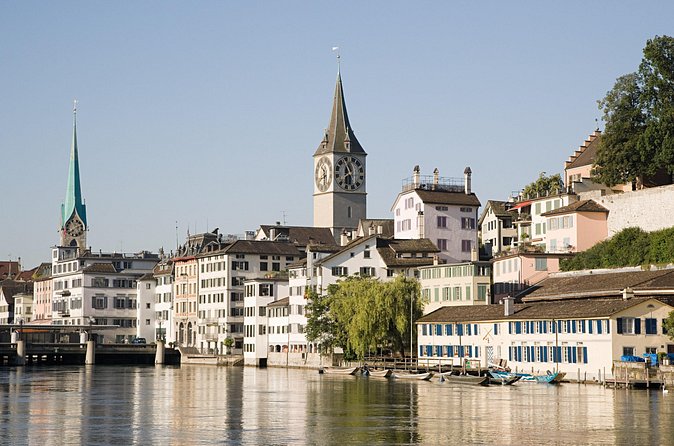
- The clock-face church and the Romanesque tower climb
- Quaibrucke and Limmatquai: your best postcard moments
- Utoquai 34 and the Rathaus: river life and city government architecture
- Dadaism, Switzerland’s largest art museum, and the police HQ frescoes
- Park in the sky vertical garden and the Lake Zurich finish
- Navigation, audio, and how to make the app work for you
- Who this tour suits best
- Should you book this Zurich self-guided Alpine Expedition?
- FAQ
- How long is the self-guided tour?
- What does it cost?
- Is the tour guided by a person?
- What language is the tour offered in?
- Are museum tickets included?
- How do I get access to the tour content?
- Is there free cancellation?
Key highlights worth planning for
- A 6 hours 30 minutes route built for an easy first day in Zurich
- Marc Chagall stained glass plus Gothic calm in a key downtown church
- Lindenhof Hill views and a Roman-era viewpoint that ties the city together
- Europe’s largest clock face (8.7 meters) and a chance to climb for panoramas
- Dadaism origins from 1916 and art stops in surprising places, like the police headquarters
- Lake Zurich at the end for that proper alpine-weather finish, with cruise or paddleboarding as an option
Price and what you really get for $2.36
At $2.36 per person for a 6 hours 30 minutes self-guided experience, this is basically a low-cost way to turn a half day in Zurich into a structured walk. You are not paying for a live guide, and you are not buying museum access. Instead, you are paying for a digital city map and an app that lays out a route and tells you what to look at along the way.
That pricing matters because it changes how you should approach the day. If you want the best value, treat it like a city orientation plus a highlight walk. You can still choose upgrades based on your interests, like tower visits or museum time, but you are not forced into paid attractions.
One more practical note: the tour is mobile-ticket based and offered in English. Since it is near public transportation, you can also hop on and off if your feet are tired or if weather changes your plans.
The route starts at Lindenhof Hill, then slowly builds
You begin in the Old Town area with Lindenhof hill, which is a smart starting point. You get elevated views early, and it helps your brain build a simple map of Zurich before you drop down into street level. From there, the walking flow feels natural, because each stop is close enough to keep the momentum going.
Old Town here is not just pretty buildings. You are guided to look at the medieval street pattern, the cozy feel of the lanes, and the way the city’s historic core still shapes where people walk today. There are shops and cafes along the way, so it is easy to pause without feeling lost.
Then you transition to Bahnhofstrasse, Zurich’s famous shopping street. Even if you do not plan to shop, you will enjoy the contrast it creates. You go from old cobblestones to elegant storefronts and high-end window displays. It is a good moment to notice how Zurich turns wealth into architecture and design, not just brands.
If you like your sightseeing in a clean sequence, this part delivers.
More Self-Guided Trails in Zurich
- Zurich: City Bus Tour with Audio Guide and Lake Cruise
★ 4.3 · 1,195 reviews - Zurich City Tour with Audio Commentary
★ 4.0 · 372 reviews - Zurich: City Top Attractions Tour by Bus with Audio Guide
★ 4.3 · 282 reviews
Bahnhofstrasse to the waterfront: Zurich’s two faces in one day
After the shopping street, the tour shifts you toward Zurich’s riverside character, where the city’s working past is still visible. You are sent to a historic riverside quarter once linked to boat builders and fishermen. That detail matters because it changes how you read the buildings. Instead of seeing only photos and facades, you look for signs of craftsmanship and trade in the shapes of the streets and the way the riverfront is arranged.
Next comes a major art moment: Marc Chagall stained glass windows. The tour has you step inside an iconic Zurich church and focus on those vibrant panels. Even if you are not a stained-glass superfan, this stop is worth making time for because the windows are the kind of artwork you cannot fully understand from the sidewalk. Taking a slower minute inside helps you notice the color, the biblical scenes, and how the Gothic space frames the glass.
Timing-wise, the tour keeps you moving at a comfortable pace, with short and medium stops. That works well if you want a full day without feeling like you are trapped in a rigid schedule.
Lindenhof Hill and Augustinergasse: views plus photo-worthy side streets
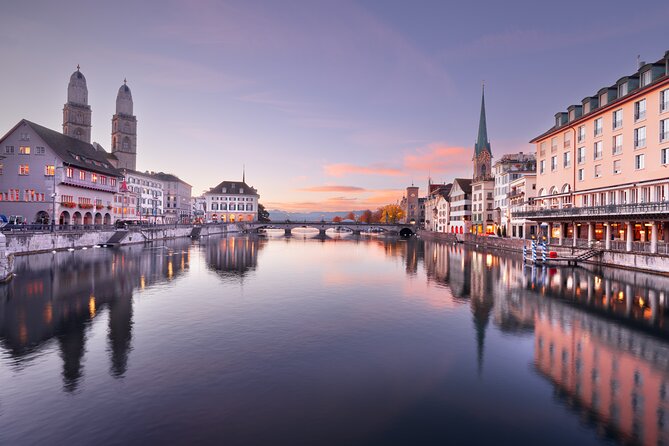
Back up at Lindenhof Hill, you get panoramic views over Zurich’s Old Town and the Limmat River. The big reason I like this stop is that it gives you context. After walking the lanes below, you finally see how the city sits along the water and how the neighborhoods connect.
You are also pointed toward the site of a former Roman castle. That single reference helps you connect Zurich’s modern look to earlier layers of settlement, even if you do not plan to do any deep archaeology reading. It is more about sparking curiosity than turning this into a textbook.
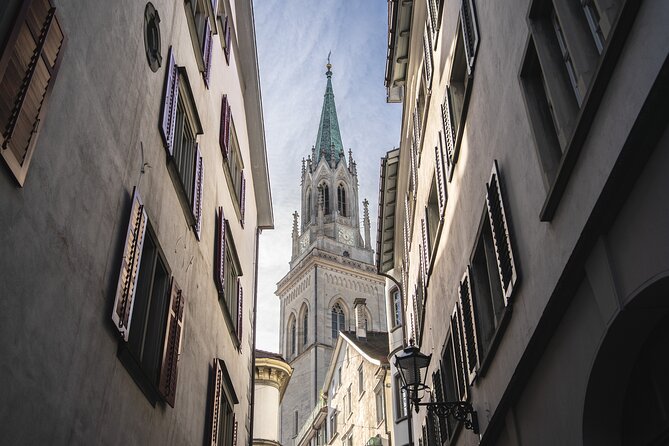
Then the route heads to Augustinergasse, one of Zurich’s most picturesque streets. You will be watching for colorful shutters and ornate wood carvings, which is exactly the kind of detail that makes side streets memorable. If you like street photography, you will likely linger here longer than the allotted time, because the facades reward slow looking.
If you do not want to overthink it, here is your simple strategy: take one wide photo for the street, then one close-up for the carvings. You will capture the street’s vibe without needing hours of wandering.
The clock-face church and the Romanesque tower climb
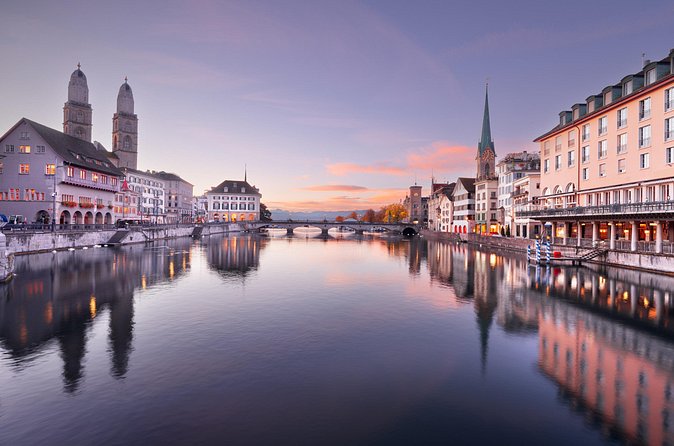
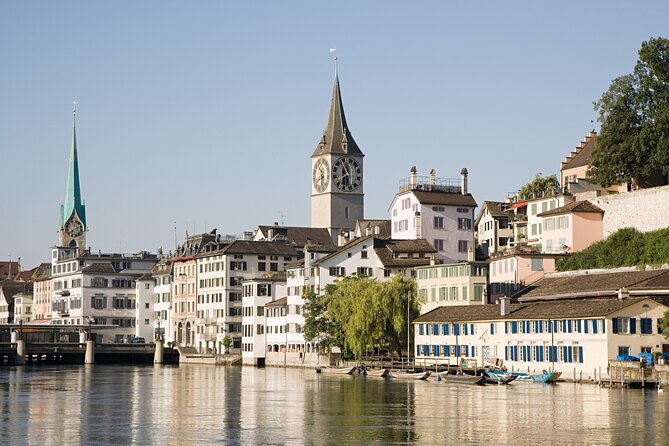
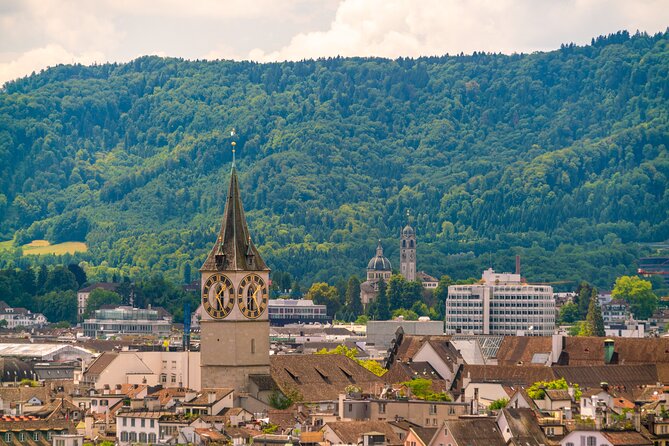
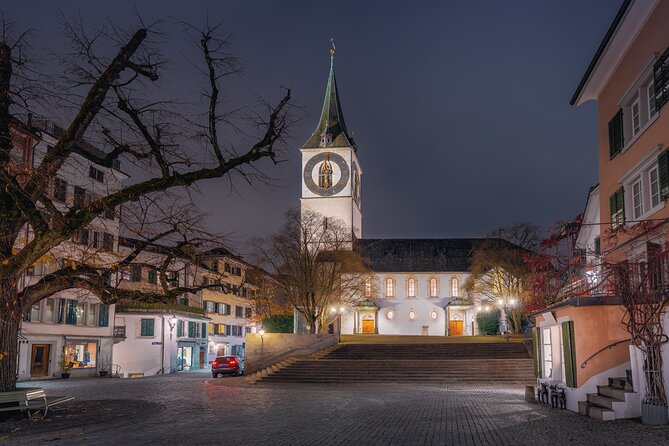
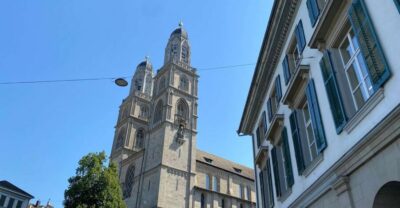
One often-overlooked church is part of the route, and it has a big claim to fame: Europe’s largest clock face, measuring 8.7 meters in diameter. That number is so specific that it is easy to remember, and it makes the stop feel more intentional than a random church visit.
Inside, you are guided to appreciate the simple yet elegant interior and the stained glass windows. Even if you do not read every sign, you still get the key experience: a calm interior that contrasts with the city’s shopping energy.
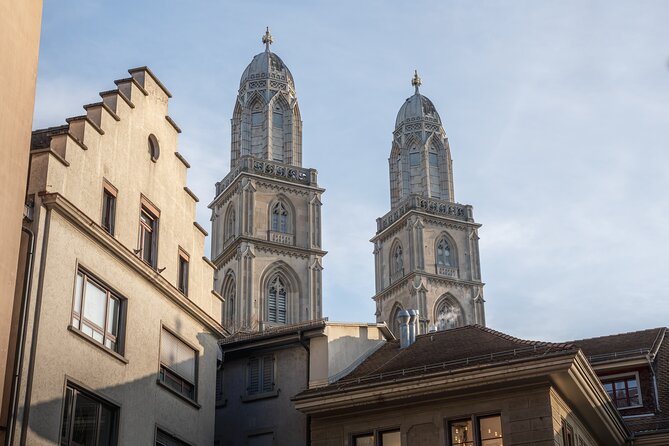
The tour then includes a tower option at an iconic Romanesque-style church with twin towers. You are encouraged to climb for panoramic views of Zurich. There is also context about the church’s role in the Swiss Reformation, which adds meaning beyond the view.
Because museum and attraction fees are not included, keep your eyes open for any paid tower access. If you want the climb, budget a little extra time and cash, since costs vary by site rules.
Quaibrucke and Limmatquai: your best postcard moments
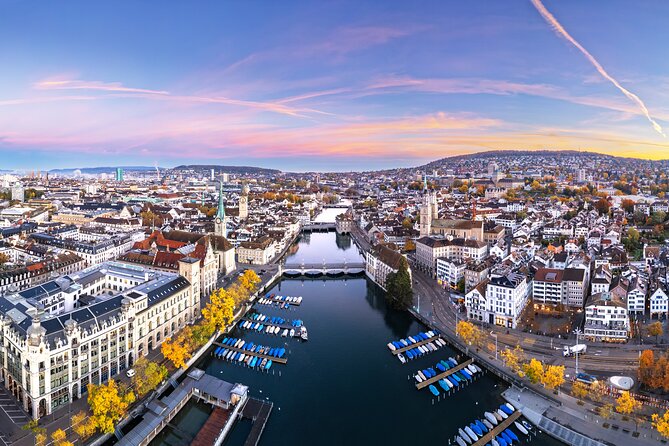
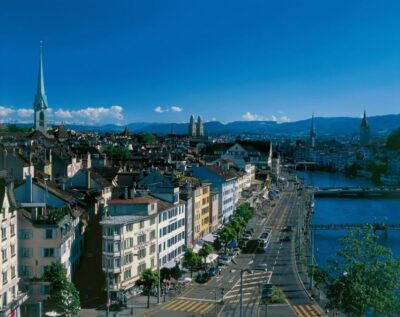
Quaibrucke is the kind of bridge stop that turns into a quick ritual. You stand here for a photo opportunity built around the classic Zurich view, with Lake Zurich, the Old Town, and even distant Alps on a clear day. This is one of the stops that makes the name Alpine Expedition feel real, because the backdrop is not just mountains in theory.
What makes this bridge time useful is that it is short but high-impact. You can get your photos, watch boats and trams move through the scene, and then keep walking without losing your day.
From there, Limmatquai takes over with a riverside promenade lined with historic guild houses and cafes. Here the vibe changes from image-capture mode to people-watching mode. You will see terraces along the water, so it is easy to grab a drink or snack and just let the afternoon roll.
A practical tip: this is a good place to take your longest pause. If you only have energy for one sit-down break, make it here.
Higher up, or further along the lake:
- Lindt Home of Chocolate Museum Entry Ticket★ 4.7 · 9,329 reviews
- Zurich: Grindelwald, Interlaken & Lauterbrunnen Day Trip★ 4.6 · 7,123 reviews
- Zurich: City Tour, Cruise, and Lindt Home of Chocolate Visit★ 4.5 · 4,624 reviews
- From Zurich: Bus Day Trip to Heidiland and Liechtenstein★ 4.5 · 2,531 reviews
Utoquai 34 and the Rathaus: river life and city government architecture
Utoquai 34 is where Zurich loosens up. The route pushes you toward lakeside parks and promenades, plus the idea of public bathing areas in Lake Zurich. Even if you do not swim, the space gives you a chance to recover your legs and reset your eyes from streets and buildings.
The route also highlights the view of Lake Zurich and the Alps, and it encourages a stroll along tree-lined paths. This is Zurich’s version of a decompression walk, and it is a strong choice if you are traveling with energy levels that swing during the day.
Then comes the Rathaus area, where you look at the Zurich city hall built partially over the Limmat River. The focus is on the Renaissance-style facade and how the building reflects in the water below. This stop is interesting because it shows you that Zurich’s landmarks are not just on land. The river shapes the architecture and the mood.
Dadaism, Switzerland’s largest art museum, and the police HQ frescoes
For culture lovers, this mid-to-late part of the route is where it turns from sightseeing to story. The tour points you to a historic venue where Dadaism began in 1916. That is a big year, and it gives you a concrete anchor for the art movement, even if you only skim what is on display.
Next up is Switzerland’s largest art museum, with a collection that includes works by Monet, Van Gogh, Picasso, plus Swiss masters such as Hodler and Giacometti. The key is that the tour frames this as time to slow down. If you are the type who normally rushes galleries, consider this a reminder to stop for a couple of pieces that actually catch your attention.
Then you get something delightfully odd, in a good way. The route includes the entrance hall of Zurich’s police headquarters featuring frescoes by Augusto Giacometti, with floral designs and geometric patterns. The wow factor here is the location. You are reminded that major art sometimes lives in places you would never expect.
If you plan your time, this section can make the day feel richer without making it exhausting. Just remember that museum entries and attraction fees are not included, so decide in advance what you want to pay for.
Park in the sky vertical garden and the Lake Zurich finish
The tour ends with a vertical garden built on the framework of a former factory, often described as a park in the sky. You climb through different levels for different perspectives, which is exactly what you want when you have spent hours on street level and river level.
This stop works because it gives you height and greenery at the same time. It is a nice contrast with Zurich’s stone and water days.
Finally, there is Lake Zurich time. The tour suggests starting the day with a morning cruise or paddleboard session, and it pairs that with the promise of mountain views and village shoreline scenery. You do not need to commit to a paddleboard to enjoy Lake Zurich, but if you are flexible and want that extra alpine feeling, this is where it fits.
Keep one simple rule: check conditions for water activities. If the weather does not cooperate, choose a lakeside walk instead. The route is already built to work even when you skip the sporty part.
Navigation, audio, and how to make the app work for you
A recurring snag with self-guided phone tours is that you need good audio and clear directions. The provided experience uses an app and a digital map, which is great when it is smooth. But if you cannot hear the audio well, you will lose the whole point of the narration.
So I strongly recommend: bring headphones, charge your phone, and set your volume before you start walking. Also, do not wait until you are standing at a corner to figure out where to go next. Check the next stop name and location ahead of time, then let your phone map guide your turn-by-turn steps.
This is the difference between a calm day and a frustrating one. With a little prep, the app becomes your shortcut to context, not a puzzle.
Who this tour suits best
This self-guided Zurich walk is a strong fit if you want:
- A structured overview of Zurich without booking a private guide
- A route that mixes major sights with lesser-known details like riverside workshops and the police HQ frescoes
- A half-day pacing that still leaves room for breaks and optional paid stops
It is also ideal if you are traveling as a group and want only your party on the tour, since it is private.
If you hate any tech dependence or you need very strict turn-by-turn guidance with lots of handholding, you might find this style stressful. In that case, consider a guided tour instead.
Should you book this Zurich self-guided Alpine Expedition?
I would book it if you like the idea of a cheap, app-based walking day that hits the highlights plus a few surprises. The best value here is the way it connects viewpoints (Lindenhof Hill, Quaibrucke), landmark art (Chagall stained glass), and culture stops (Dada origins, Giacometti frescoes) into one coherent flow.
I would hesitate if you know you struggle with audio tours, or if you want the next stop instructions delivered so clearly that you never have to check a map. If you are willing to use headphones and keep your navigation simple, this becomes a practical way to see more Zurich in less time.
FAQ
How long is the self-guided tour?
The experience lasts about 6 hours 30 minutes.
What does it cost?
The price is $2.36 per person.
Is the tour guided by a person?
No, there is no in-person guide. You explore independently with the digital tour app.
What language is the tour offered in?
The tour is offered in English.
Are museum tickets included?
Museums and tourist attraction fees or tickets are not included.
How do I get access to the tour content?
You receive a mobile ticket, and you get a digital city map plus a self-guided walking tour through the app.
Is there free cancellation?
Yes. You can cancel up to 24 hours in advance for a full refund.
Added lately around Zurich


Self-Guided Trails in Zurich, compared.
City Bus Tour with Audio Guide and Lake Cruise
Read our review →
City Top Attractions Tour by Bus with Audio Guide
Read our review →
Audio Guided City Tour and Train to “Top of Zurich”
Read our review →
The Dark Side of Zurich: Self-Guided Audio City Tour
Read our review →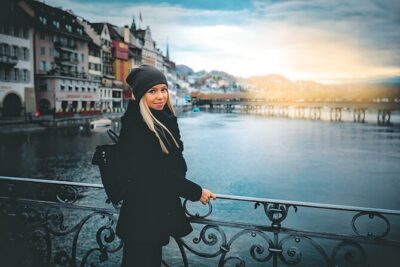
Einstein in Zurich: Walk in Time Exploration Game and Tour
Read our review →
Zurich in the Mirror of the Past: Self-Guided Audio Tour
Read our review →Browse the lists this tour appears in