
Reviewed · CITY TOURS
Self-Guided Reading City Tour in Zurich
Zurich reads like a city-sized story. This self-guided reading tour strings together famous sights and the people behind them, using a mobile route with photos and step-by-step directions. You hit major checkpoints like Grossmünster, Fraumünster, St. Peter’s Church, Cabaret Voltaire, and Lenin’s Zurich address, plus several statues and riverside churches.
I especially like two things. First, most stops are free to visit, so your money goes mostly into the route and the written context. Second, the stories are not just names and dates, you get themes like education, reformation, political exile, and even the moral gray areas of famous figures.
One heads-up: there is no live guide, so you are reading on your phone using the link after booking. And if you read slowly, this can take closer to the full 2 to 3 hours, since the experience is built around the text, not quick photo stops.
In This Review
- Key things you will notice on this Zurich reading walk
- Price and time, and why this feels like value
- Start at Bahnhofplatz, finish at the Max Bill Pavilion (and stay walkable)
- Alfred Escher to Urania: Zurich’s power, education, science, and viewpoints
- A practical tip for this section
- St. Peter’s Church and Thermengasse: clocks, oldest parish roots, and Roman baths
- Rathaus, Cabaret Voltaire, and Lenin’s House: civic power to Dada to exile
- The emotional range is the point
- Grossmünster and Fraumünster stained glass: Augusto Giacometti vs Marc Chagall
- How to decide about the CHF 5 fee
- Walking downtown: Paradeplatz, Bahnhofstrasse, and Zurich’s civic and financial rhythm
- Opera facade art, Ganymed, and Hans Waldmann’s darker arc
- Why this “not-all-good” approach is worth it
- Weinplatz guild buildings and Max Bill’s #KiöR ending
- Who this Zurich self-guided reading tour is best for
- Should you book this Zurich reading city tour?
- FAQ
- FAQ
- How long does the Zurich self-guided reading city tour take?
- What does it cost, and do I pay anything extra?
- Do I need my own mobile phone for this tour?
- Is there a live guide during the walk?
- Where does the tour start and end?
- What ticket do I receive for the tour?
Key things you will notice on this Zurich reading walk
- Mobile ticket plus a phone link: You follow along with a provided route, not a guide in person.
- A story-driven route through big ideas: reformers, revolution, education, civic power, and art movements.
- Stained glass you can actually focus on: Augusto Giacometti at Grossmünster and Marc Chagall at Fraumünster.
- Roman Zurich shows up in the middle of Old Town: Thermengasse points you to ancient Roman baths.
- Short stops that add up: most locations are 5 to 10 minutes, so you keep moving without rushing.
- Great value at $6.23 per person: you’re paying for the “read the city” part across many checkpoints.
Price and time, and why this feels like value
At about $6.23 per person, this is one of those deals that makes you think, why didn’t I do a format like this earlier? Most listed stops are free, and the route covers a lot of ground in Old Town and near downtown, so you do not have to purchase multiple individual tickets to make it worthwhile.
The duration is listed as 2 to 3 hours, and that timing makes sense for a self-paced reading format. If you treat it like a casual walk with zero reading, it will feel short. If you actually read the guided text at each stop, you should plan for the longer end of the estimate, since the experience is built around what you’re reading.
One practical note for your planning: Fraumünster is the only stop clearly flagged with an entrance fee if you want to see the church interior. So if you want to keep costs tightly controlled, you can still enjoy the exterior area and only pay the CHF 5 if you decide the stained glass interior is worth it for you.
Start at Bahnhofplatz, finish at the Max Bill Pavilion (and stay walkable)
The tour starts at Bahnhofplatz (8001 Zürich) and ends next to the Max Bill Pavilion Sculpture on Bahnhofstrasse 47 (8001 Zürich). That end point matters because Max Bill’s work sits in the same downtown zone that many people already want to visit, so your route doesn’t feel like a detour into the unknown.
Because the tour is near public transportation, you also have flexibility if you need to pause, reset, or hop between points. The format is designed for walking, but it is not a remote hike.
Also, this is listed as a private activity, meaning only your group participates. In real life, that usually translates into an easier pace, since you’re not forced to keep up with a pack or wait for someone who is slow at stairs and doorways.
More City Sightseeing in Zurich
- Zurich: City Tour, Cruise, and Lindt Home of Chocolate Visit
★ 4.5 · 4,624 reviews - Zurich: City Highlights Tour by Bus, Cable Car, and Ferry
★ 4.4 · 2,366 reviews - Zurich: City Bus Tour with Audio Guide and Lake Cruise
★ 4.3 · 1,195 reviews
Alfred Escher to Urania: Zurich’s power, education, science, and viewpoints
The opening stops do a smart job of setting the tone: Zurich is not only about pretty facades, it’s about the people who shaped systems.
You start at the Alfred Escher Statue, connected to Swiss politics, and especially the economy and railway system. From there, you move to the Pestalozzianlage and its monument to Johann Heinrich Pestalozzi, which frames education as a force for social change. If you like your travel with ideas, these first two points give you a theme you can carry through the whole walk.
Next comes an unlabeled step that points you to the Urania Observatory, where the wonders of the cosmos are made more vivid. It’s a quick stop on paper, but it breaks the pattern of political and religious landmarks, reminding you that Zurich has a science and curiosity side too.
Then you head to Lindenhof Hill, one of those places that feels calm even when the city around it is busy. Here you get panoramic views of the Limmat River and the city. The text at this stop also nudges you to look for specifics like the Hedwig Fountain, the Masonic Lodge, and the Tombstone of Lucius Aelius, which adds an unusual blend of architectural detail and a slightly eerie, human-time feeling.
A practical tip for this section
Bring a little patience for photos here. Lindenhof is the kind of viewpoint where you can get distracted and lose track of time, but that’s also part of why it works for a reading-based tour. You’ll want a few minutes to actually look.
St. Peter’s Church and Thermengasse: clocks, oldest parish roots, and Roman baths
One of the most satisfying parts of this tour is how it layers time periods without making you work for it.
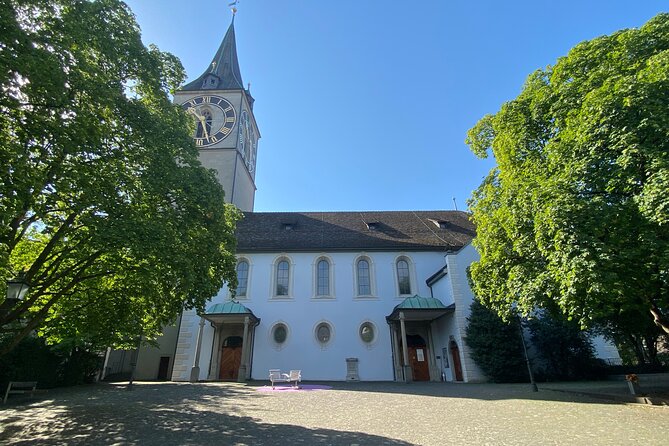
At St. Peter’s Church, you get the oldest parish church framing, plus that famous clock face. The tour highlights the clock face as one of the largest in Europe, and it’s the kind of detail that turns a stop from a quick glance into a more focused moment.
From there you go to Thermengasse, tied to ancient Roman baths. This is a neat pivot because many Zurich visitors never connect the city to Roman-era remains. With this stop, the walk starts to feel like a conversation between modern streets and older underlayers, all without taking you far out of your comfort zone.
If you want the easiest win on this section, do not rush the doorway moments. Even if you only spend a few minutes reading, the Roman-baths stop changes how you interpret the city right away, because it forces your brain to stop thinking of Zurich as purely medieval or purely modern.
Rathaus, Cabaret Voltaire, and Lenin’s House: civic power to Dada to exile
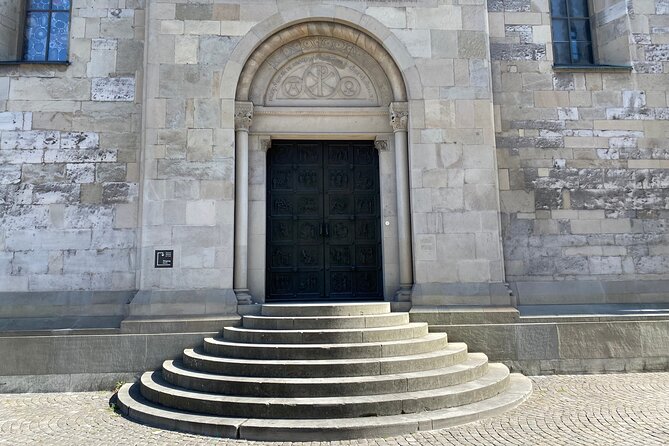
The tour moves from old-town churches into a “people and ideas” zone that feels like a history quiz, but on the street.
At the Town Hall (Rathaus), you focus on Zurich’s political heritage. It’s a short stop, but the idea is clear: this city is built around civic decisions, and the written text encourages you to connect those decisions to the big names you’re seeing.
Then you reach Cabaret Voltaire, described as the birthplace of the Dada movement. Cabaret Voltaire here is not treated like a random arts stop. The emphasis is on how avant-garde thinkers used performance and provocation to challenge what society expected.
Next is Lenin Apartment Zurich, the place that housed Vladimir Lenin during political exile. This is a striking contrast to Cabaret Voltaire, and it’s one reason this tour works well: it refuses a single storyline. You get one city block that points to artistic disruption and another that points to political disruption.
More Self-Guided Trails in Zurich
- Zurich City Tour with Audio Commentary★ 4.0 · 372 reviews
- Zurich: City Top Attractions Tour by Bus with Audio Guide★ 4.3 · 282 reviews
- Zurich: Audio Guided City Tour and Train to “Top of Zurich”★ 4.2 · 65 reviews
- The Dark Side of Zurich: Self-Guided Audio City Tour★ 4.4 · 52 reviews
The emotional range is the point
If you like travel that goes beyond postcard mood, you’ll appreciate this section. It’s not only celebration, it’s also power, exile, and the tension between ideas that change lives for better or worse.
Grossmünster and Fraumünster stained glass: Augusto Giacometti vs Marc Chagall
If you want two different stained-glass “feels” in Zurich without guessing where to start, this tour sets you up well.
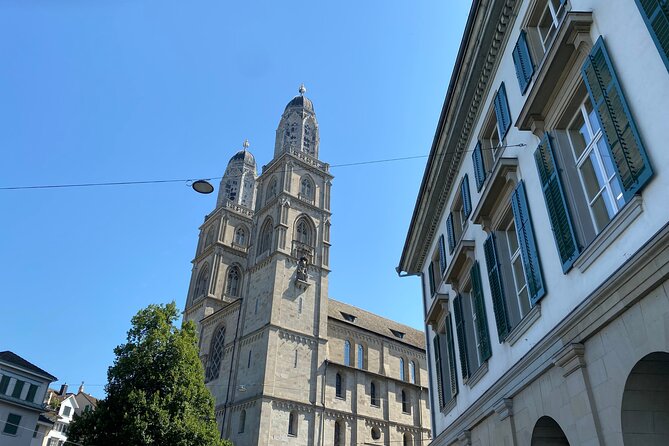
At Grossmünster, the focus is on the twin towers and its role in the Swiss Reformation. The stained glass windows by Augusto Giacometti are a centerpiece, and the description encourages you to notice how color and light play together inside the sacred space.
Then comes Wasserkirche, along the Limmat River, again highlighting stained glass windows. It’s another quick stop, but it keeps you in the stained-glass zone long enough to make the theme feel intentional rather than accidental.
Finally, you reach Fraumünster, known for stained glass designed by Marc Chagall. This is the stop that may cost extra: if you want to see Fraumünster from the inside, it is subject to an entrance fee of CHF 5. If you’re cost-conscious, you can still enjoy the surrounding setting, but the tour is clearly steering you toward the interior experience for the stained glass.
How to decide about the CHF 5 fee
If stained glass is a “yes” for you, plan on paying it. If you’re more about exterior views and quick reads, you can skip the interior without breaking the flow of the route.
Walking downtown: Paradeplatz, Bahnhofstrasse, and Zurich’s civic and financial rhythm
As the route heads into the downtown heart, the vibe changes from monuments and churches to the city’s daily pulse.
The tour explicitly flags Paradeplatz as the bustling center of Zurich’s financial district. This is where you can feel the modern city moving around the older layers you’ve been reading about. It’s a good reset moment, because by now you’ve been absorbing big ideas like reformation and political exile.
You also pass through the broader Bahnhofstrasse zone, which is part of why the tour feels practical for visitors who want to combine a walk with normal sightseeing. Even if you’re not buying anything, it helps to end the morning or afternoon with streets that are easy to navigate.
In the middle of the downtown rhythm, you have the Augustinerkirche stop. It’s described as a humble church with a sense of quiet reflection. This works as a breathing space after the fast-moving feel of the financial district.
Opera facade art, Ganymed, and Hans Waldmann’s darker arc
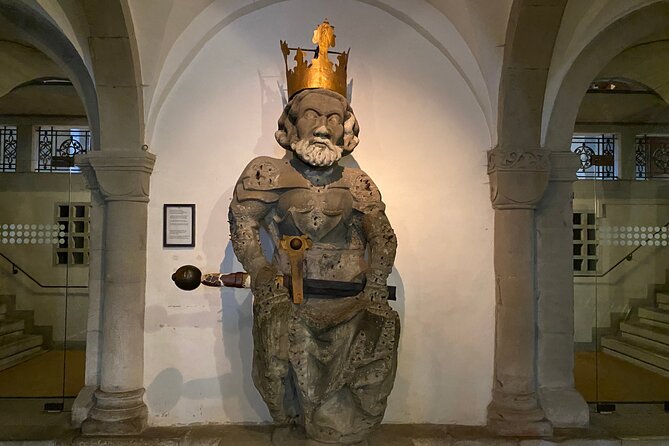
Zurich has a habit of mixing culture with power, and this part of the walk keeps that balance.
At the Opernhaus Zurich, you’re asked to look at the facade details, including busts of eminent composers and writers. It’s a quick stop, but it trains you to see the building as a layered cultural statement, not just an exterior you pass.
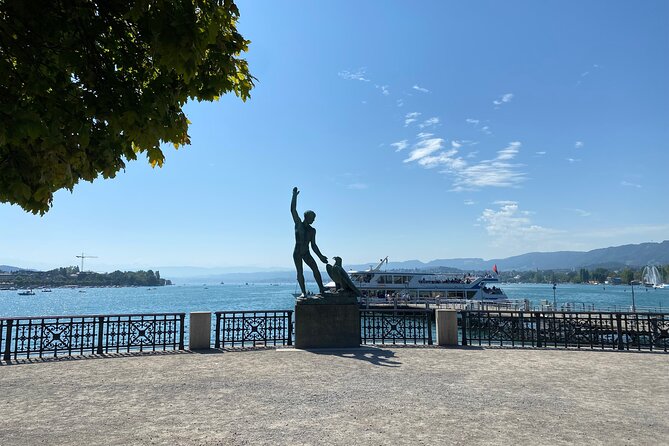
Then you reach Ganymed, a sculpture tied to mythological narrative. The stop stays short, yet the presence of a sculpture named after a myth makes your walk feel like it spans not only eras, but also storytelling styles.
The Hans Waldmann statue adds a darker storyline. The text highlights his rise from humble beginnings to burgomaster, his influence, and his end by sentence to death. That arc matters because the tour is not only about heroes. It’s about how authority can elevate a person and also destroy them.
Why this “not-all-good” approach is worth it
You’ll come away with more than “this person was important.” You get a sense of consequence, ambition, and the cost of power. For many people, that’s what turns a walking tour from background noise into something you remember.
Weinplatz guild buildings and Max Bill’s #KiöR ending
The final stretch ties everyday work, design, and public values into a satisfying ending.
At Weinplatz, you’re directed to the Millers’ and Bakers’ Guild Building. This is one of those stops that can feel minor if you’re chasing only famous landmarks, but it grounds you in city life and the kinds of work that built wealth and influence.
Then you finish with the Pavillon-Skulptur von Max Bill (1983) (#KiöR). The description is very specific about what it represents: transparency, equality, and freedom. End a walking story on a piece of public art about values, and the whole route suddenly feels less like sightseeing and more like a guided reflection on how societies organize themselves.
And since your finish point is right on Bahnhofstrasse, it’s easy to continue to dinner, transit, or an extra museum stop you might be considering.
Who this Zurich self-guided reading tour is best for
This is a great fit if you like slow travel in a practical way. You don’t have to hunt for context or wonder what to notice, because each stop has written guidance built for your phone.
It also works well if you think you already know Zurich. One person described being a longtime resident and still learning surprising details. That’s a strong sign the route does more than recycle surface facts.
You might want to skip it if you hate reading on your phone. This tour is designed around the text, not just the walk. Also, if you need a live guide to answer questions on the spot, the no-live-guide format could feel limiting.
Should you book this Zurich reading city tour?
Book it if you want structured walking time plus stories that connect major sights and lesser-seen details. At $6.23 per person, you’re paying a small amount for a route that strings together monuments, churches, stained glass, Roman remains, and modern civic life, with most stops free.
Pass or swap to a different option if you prefer a live guide, or if you know you will not read much while walking. With this format, your enjoyment rises with how much you’re willing to stop and read.
One final practical note: cancellation is listed as free, and you can cancel up to 24 hours in advance for a full refund.
FAQ
FAQ
How long does the Zurich self-guided reading city tour take?
The tour is listed as about 2 to 3 hours.
What does it cost, and do I pay anything extra?
The price is $6.23 per person. Fraumünster has an additional entrance fee of CHF 5 if you want to see it from inside.
Do I need my own mobile phone for this tour?
Yes. You need your own mobile phone with internet, and you will use the link provided after booking.
Is there a live guide during the walk?
No. There is no live guide, and you explore using the link provided after booking.
Where does the tour start and end?
It starts at Bahnhofplatz 8001 Zürich and ends next to the Pavillon-Skulptur von Max Bill (1983) on Bahnhofstrasse 47, 8001 Zürich.
What ticket do I receive for the tour?
You get a mobile ticket.
Added lately around Zurich


City Tours, compared.
City Tour, Cruise, and Lindt Home of Chocolate Visit
Read our review →
City Highlights Tour by Bus, Cable Car, and Ferry
Read our review →
City Bus Tour with Audio Guide and Lake Cruise
Read our review →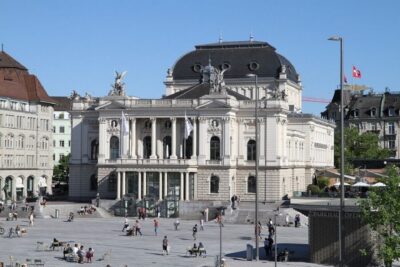
City Tour with Lake Cruise + Optional FIFA Museum
Read our review →
Best of Geneva City Tour: International Area and Old Town
Read our review →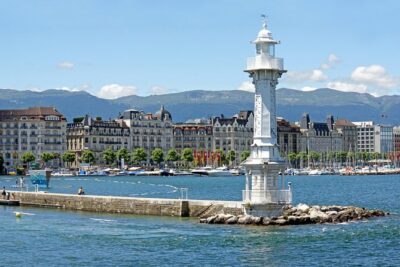
Best of Geneva City Tour with optional boat cruise
Read our review →
Browse the lists this tour appears in