
Reviewed · WALKING TOURS
Private Walking Tour in Lucerne
Lucerne hits you fast. This private walk strings together the city’s most recognizable sights with the stories that explain why they matter. It also runs as a true small-group experience, up to 8 people, with an English-speaking guide and a mobile ticket for easy check-in.
I like two things a lot. First, you get a tight route that covers major landmarks like Chapel Bridge and the Lion Monument without wasting time getting your bearings. Second, the guide style is practical and story-driven, and Iuliia is a great example of how this tour turns quick stops into clear connections and even helpful ideas for the rest of your day.
One possible drawback is simple: time per stop is short, so if you only care about one or two headline sights, the full price can feel steep. In other words, this is best when you enjoy walking through town and learning along the way, not when you want a long stay at each photo spot.
In This Review
- Key things you’ll notice on this Lucerne private walk
- Where you meet and how the walk is paced
- Europa Platz and KKL Luzern: starting with the city’s modern anchor
- Lake Lucerne viewpoints: trade routes, royalty, and a famous hotel clue
- Chapel Bridge: the oldest covered wooden bridge and its painted stories
- Fritschibrunnen: why a “straw puppet” matters in Lucerne
- Old-town squares: Weinmarkt, Muhlenplatz, Kornmarkt, and Pfistern
- Jesuitenkirche Luzern and the role of education after the Reformation
- Spreuer Bridge and the Dance of Death paintings
- Musegg Wall and the nine towers view from up high
- Lion Monument: the dying lion carved from living rock
- Price and value: who this private tour works best for
- Practical tips to get more out of your 3-hour walk
- Should you book this Lucerne private walking tour?
- FAQ
- What is the price for this Lucerne private walking tour?
- How long is the tour?
- Is the tour offered in English?
- Where does the tour start and end?
- Do I need a paper ticket?
- What admissions are included?
- Is this a private tour?
- What is the cancellation policy?
Key things you’ll notice on this Lucerne private walk
- Built-in ticket moments at most stops, so you spend less time figuring out admissions and more time looking.
- Short, high-impact stops (often around 5 to 10 minutes), which works well for first-time orientation.
- Layered stories, like 13th-century commerce and 19th-century tourism tied directly to the Lake area.
- Old wooden bridge art and symbolism, including the Chapel Bridge painting scenes and the life-and-death theme on Spreuer Bridge.
- A seasonal Musegg Wall view, with a tower climb running from April through the end of October.
Where you meet and how the walk is paced
You start at Torbogen Luzern, Bahnhofpl., 6003 Luzern. The route ends at the Lion Monument, Denkmalstrasse 4, 6002 Luzern, so you’ll finish in a perfect spot to keep exploring old Lucerne on foot or relax near the memorial area.
This is a private tour, meaning only your group participates. With a group size of up to 8, you’ll generally get the comfort of small-group attention, and you can ask questions without a crowd cutting you off.
The walk lasts about 3 hours, so it’s paced for movement rather than lingering. That pacing shows up in the timing of the stops, which are mostly quick looks, short context, and then on to the next landmark.
Europa Platz and KKL Luzern: starting with the city’s modern anchor
The tour begins at Europa Platz with KKL Luzern, the Culture and Congress Center Lucerne. It’s a strong opening because it frames the contrast you’ll feel all day: modern civic space right next to some of Europe’s most famous old-town architecture.
You get a short moment here (about 10 minutes) with context that helps you read the square and the building in the larger Lucerne story. Even if you’re not here for concerts, it’s a useful way to start, because KKL sits right where travelers naturally pass through, and you’ll soon notice how Lucerne channels people from transit areas into the historic core.
Think of this first stop as a “setup chapter.” It helps you start the rest of the day with names, places, and a sense of where things sit relative to the Lake.
More Guided Walks in Lucerne
- Lucerne: Private Walking Tour with a Local Guide
★ 4.6 · 450 reviews - Lucerne Walking & Boat Tour: The Best Swiss Experience
★ 4.5 · 417 reviews - Lucerne: Guided Walking Tour with an Official Guide
★ 4.7 · 321 reviews
Lake Lucerne viewpoints: trade routes, royalty, and a famous hotel clue
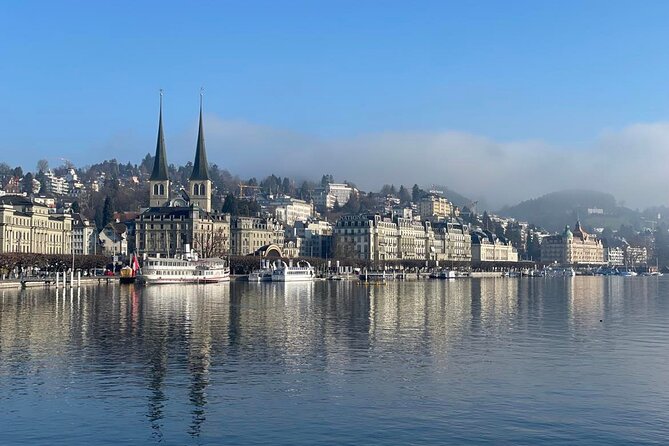
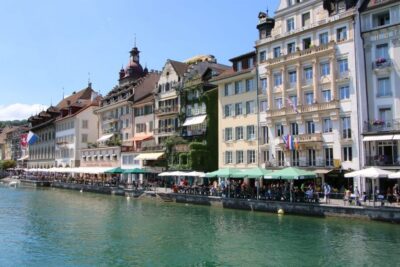
From KKL, you head to Lake Lucerne for views toward the old town. You’ll look over a scene that includes the first hotels, the fortress wall and its 9 towers, the city’s main church, and the promenade.
The guide uses that view as a storytelling machine. You’ll hear how Lucerne’s fate was shaped by 13th-century commerce and how tourism took off in the 19th century, changing what the city became to outsiders. The day also connects to famous visitors from different eras, including royalty and celebrities who stayed in Lucerne across the years.
You’ll even get the kind of detail that makes the Lake feel personal: the guide talks about the Grand Tour and the British, then brings in local mountain mentions like Riga, Pilatus, and Bürgenstock. One of the more fun payoffs is learning where the most expensive hotel in the world is located, anchored to this Lake overlook so it sticks.
Chapel Bridge: the oldest covered wooden bridge and its painted stories
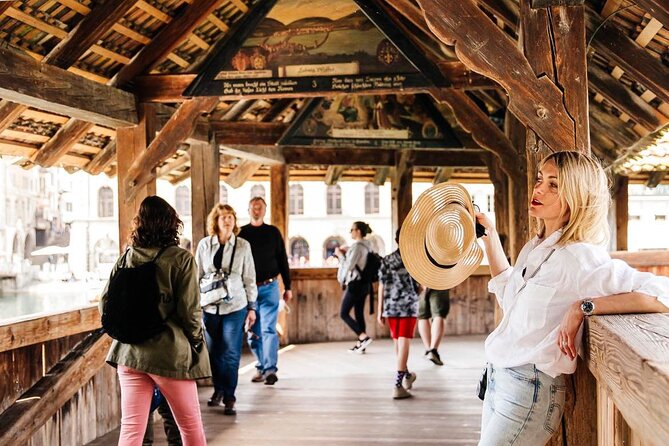
Chapel Bridge is the big magnet for most people, and it’s also where the tour’s storytelling really pays off. Built in the early 1300s, it used to be part of the town’s fortifications. It’s also known as the oldest covered wooden bridge in Europe, and the key visual here is the 17th-century painting program.
You’ll spend about 10 minutes at the bridge. Rather than treating it as a quick photo stop, you get help reading the scenes: patron saints, and episodes from the history of the city and Switzerland. When you understand what you’re looking at, the bridge stops being only a postcard and starts acting like a public record of beliefs, power, and memory.
If you’re visiting in a hurry, this stop can still feel like a win because it blends architecture and meaning in a small footprint.
Fritschibrunnen: why a “straw puppet” matters in Lucerne
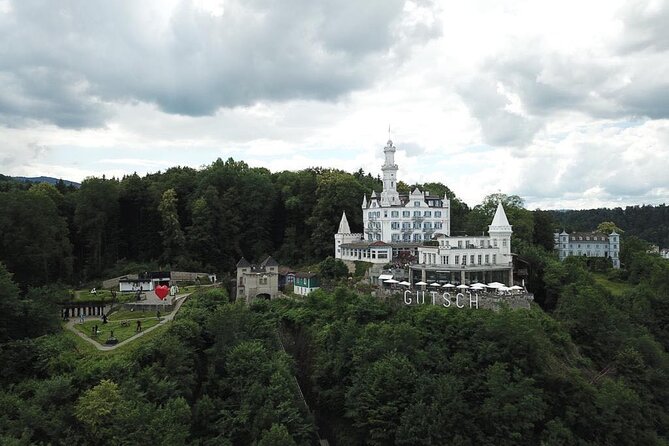
Next up is Fritschibrunnen, a fountain with a figure whose origin is not as straightforward as it looks. You’ll hear how the Fritschi custom links back to a historical meeting tied to the Lucerne and Innerschwyzer conflict in the Old Zurich War.
There’s also a vivid cultural thread. The story traces the figure to the last meeting tied to events around 6 March 1446, in line with the Alte Fasnacht timing. Then the guide helps you connect that to how Fritschi can be traced to the 15th century, when the character used to be a straw puppet, likely tied to one of the guilds.
This is a classic example of the tour’s strength. You move through a small stop for about 5 minutes, but the meaning is deep enough that you’ll remember it later while walking around the old town.
Old-town squares: Weinmarkt, Muhlenplatz, Kornmarkt, and Pfistern
Once you’re in the heart of Lucerne’s Altstadt, you’ll bounce through a sequence of squares and facades that explain how the city worked.
At Weinmarkt, the guide shares a legend about 1332, when citizens of Lucerne swore allegiance to the federation formed by Uri, Schwyz, and Unterwald. It’s a reminder that old town isn’t just pretty buildings. It’s where political identity got argued, sworn, and reinforced.
Then you’ll head to Muhlenplatz, Lucerne’s largest historic square. Here the context is practical: during the Middle Ages, the area hosted mills because it sat near the river and the hydropower was available. That turns what could be a simple open space into a working snapshot of how the city produced food and goods.
You also visit Kornmarkt for the Town Hall on Kornmarkt, built between 1602 and 1606 by Italian architect Anton Isenmann. It’s valued as a late Renaissance masterpiece, and learning the name and dates helps you appreciate the building style beyond its look.
Finally, Pfistern Guild House takes you into the guild world. The bakers’ and millers’ guild used the building. The guide also connects Pfistern to what the Romans called their bakers and ties you into the coats of arms story on the facade.
If you like European cities where daily life shaped politics and art, this cluster will feel like the tour’s core value.
Higher up, or further along the lake:
- From Zurich: Mount Titlis with Ice Flyer & Lucerne Day Tour★ 4.7 · 3,899 reviews
- Lucerne: Mt. Pilatus Cable Car, Cogwheel Train & Lake Cruise★ 4.7 · 2,338 reviews
- Mount Pilatus Summit from Lucerne With Lake Cruise★ 4.5 · 1,260 reviews
- Lucerne: Round-Trip Catamaran Cruise on Lake Lucerne★ 4.4 · 1,169 reviews
Jesuitenkirche Luzern and the role of education after the Reformation
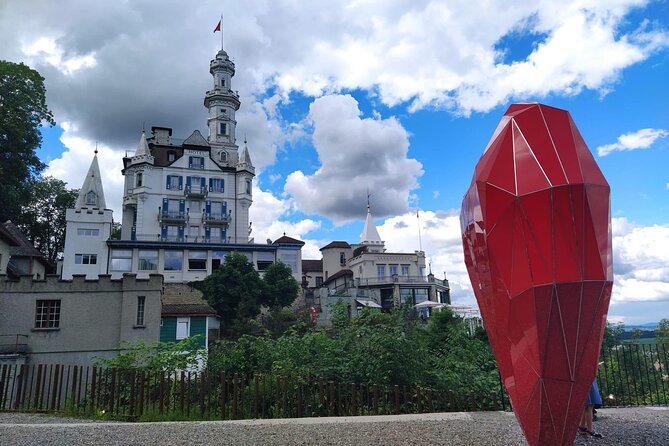
You’ll pause at Jesuitenkirche Luzern, with a short history lesson that helps explain why this part of town feels different. Lucerne stayed Catholic after the Reformation, and that sets the stage for the Jesuits arriving in 1573 to establish a college.
This matters because it gives you a reason behind the building’s presence, not just a date. When you know the religious and educational push behind the Jesuits’ arrival, it’s easier to read the church as part of a bigger city shift rather than only a scenic stop.
The time here is about 10 minutes, so you won’t get a long interior visit described in detail. Still, the context often helps you spot why certain buildings in old Lucerne have the shape and tone they do.
Spreuer Bridge and the Dance of Death paintings
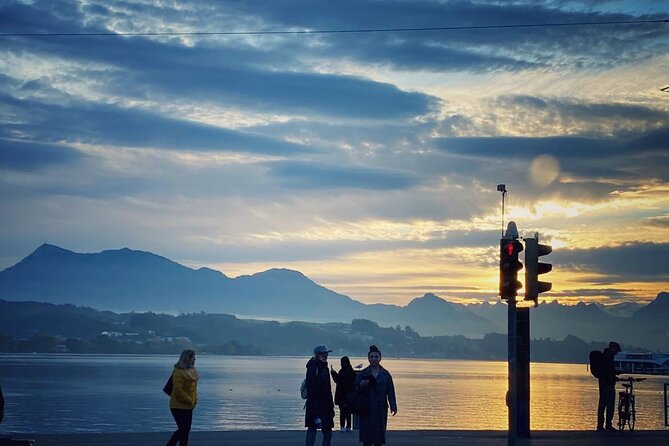
Next comes Spreuer Bridge, named from spreu, meaning chaff. The story connects to the flour mills and the River Reuss, where mills were permitted to dump waste from this bridge. It’s one of those details that instantly makes the medieval city feel real.
Like Chapel Bridge, Spreuer Bridge has a striking series of paintings. These are dedicated to the theme of life and death, known as the Dance of Death. That theme is heavy, but it’s also exactly why the art feels so memorable once you learn what it’s meant to communicate.
You’ll spend about 10 minutes here, and the payoff is the emotional clarity the guide brings to a visual series that can look strange at first glance. Even if you only catch parts from the walkway angle, you’ll leave understanding the main idea.
Musegg Wall and the nine towers view from up high
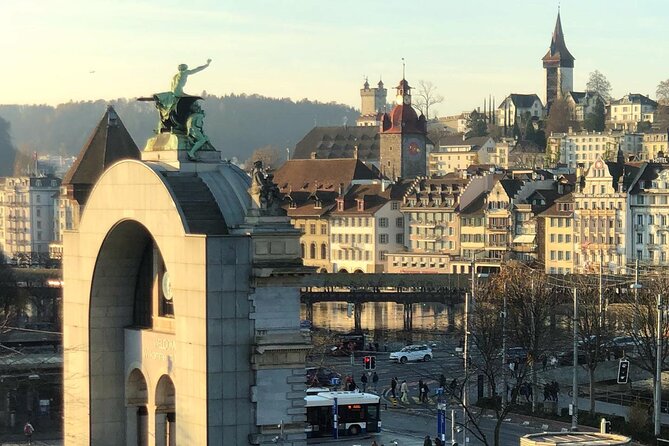
Then you reach Musegg Wall, the town’s ramparts with nine towers. This wall is part of the fortifications built in the 14th century, designed to protect Lucerne, much like the ideas behind the older bridge fortifications earlier in the day.
Here’s the key practical note. From April through the end of October, you climb one of the towers for views of the lake, mountains, and the city. In other seasons, you might just get the exterior context, so your exact experience can vary with timing.
This stop is about a 10-minute window for the walk and viewpoint moments. The value is that you’ll see how Lucerne’s defensive layout relates to the Lake edge, which ties back to those early fortress wall and 9 towers references earlier.
If you want a change of perspective without committing to a full hike, this is a good fit.
Lion Monument: the dying lion carved from living rock
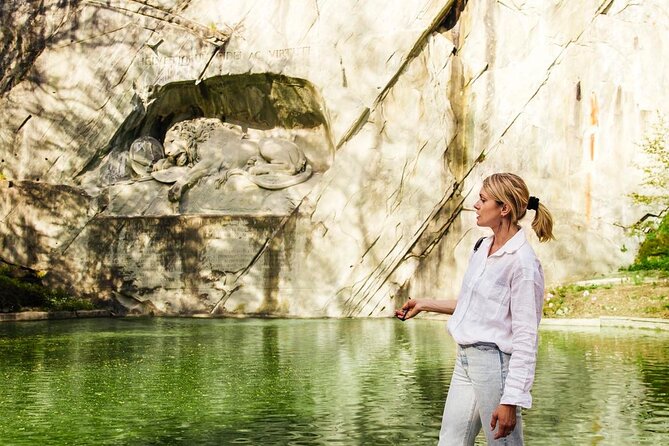
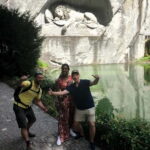
You end at the Lion Monument, one of Switzerland’s most moving memorials. The sculpture shows a dying lion carved from the living rock of the cliff, created to commemorate the Swiss guardsmen who died in 1792 during the French Revolution.
The guide shares the story with emotional weight, including a famous remark attributed to Mark Twain. The result is that the final stop doesn’t feel like a random attraction. It lands as a human scale ending to a day full of fortifications, politics, and identity.
You’ll spend about 10 minutes at the Lion Monument. That might not sound long, but it’s long enough for you to take in the details, understand the historical trigger, and then decide whether you want to linger on your own after the tour ends.
Price and value: who this private tour works best for
The price is $362.95 per group, up to 8 people, for about 3 hours. That means the real cost per person depends on how many of you show up together.
So how do you judge value fairly? I think you get the best value if you:
- Want a clear guided route through the highlights of Lucerne old town.
- Like history stories that connect buildings to events, not just names on plaques.
- Appreciate that many stops include admissions, which reduces planning friction.
You might feel it’s overpriced if your main goal is only the two most famous stops, like Chapel Bridge and the Lion Monument. The short stop timing means you see many places quickly, so the experience works as an overview and interpretation, not as a slow, museum-style deep visit.
In short, this is a strong option for first-time orientation plus guided meaning. If you’re in Lucerne for a long stay and want only a couple of moments, you may prefer spending that time elsewhere.
Practical tips to get more out of your 3-hour walk
Wear shoes you can walk in for a few hours, because this is a moving, stop-and-go route. Keep your phone charged or bring a small power bank for photos, since Chapel Bridge and both bridges can be tempting snapshot points.
When the guide gives the historical context, pause for a second before you rush to the next photo. Those stories are designed to make the next landmark easier to understand, like the way the Lake view ties to fortress layout and how the Dance of Death theme frames Spreuer Bridge.
One smart move: ask Iuliia or your guide what parts of Lucerne deserve extra time after the tour. The best guides treat the walk as a launchpad, not a finished product.
Should you book this Lucerne private walking tour?
Book it if you want a private, English-speaking guide to help you connect Lucerne’s landmarks into a coherent story in just about 3 hours. It’s especially good if you like walking through old squares and hearing why each place has a specific name and role.
Don’t book it if you only want a couple of sites and you prefer long, unhurried time at fewer places. The pacing is brisk, and the experience is designed more for overview and interpretation than for deep stays.
If you’re traveling with a small group and you want maximum value per person, it can make sense to go for the private format. You’ll finish at the Lion Monument with the kind of context that helps you keep exploring without feeling lost.
FAQ
What is the price for this Lucerne private walking tour?
The price is $362.95 per group, up to 8 people.
How long is the tour?
The tour runs for approximately 3 hours.
Is the tour offered in English?
Yes, the tour is offered in English.
Where does the tour start and end?
It starts at Torbogen Luzern Bahnhofpl., 6003 Luzern, Switzerland and ends at Lion Monument, Denkmalstrasse 4, 6002 Luzern, Switzerland.
Do I need a paper ticket?
No. You get a mobile ticket.
What admissions are included?
Admission tickets are listed as included for many stops along the route, and Luzern Theatre is noted as free.
Is this a private tour?
Yes. It is a private tour/activity, and only your group will participate.
What is the cancellation policy?
You can cancel for a full refund up to 24 hours before the experience’s start time. After that, there is no refund.
Added lately around Lucerne



Walking Tours, compared.
Zurich Walking Tour With Cruise and Aerial Cable Car
Read our review →
Lucerne Walking & Boat Tour: The Best Swiss Experience
Read our review →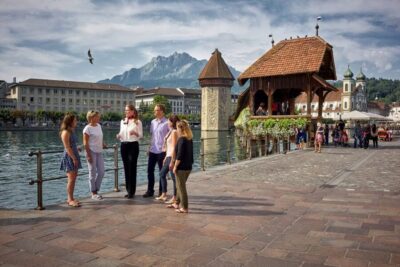
3 in 1: Zurich Walking Tour – Cruise on the Lake – Cable Car Ride to Felsenegg
Read our review →Browse the lists this tour appears in