
Reviewed · WALKING TOURS
Discover Lucerne Guided Walking Tours
Lucerne can feel like postcard after postcard. This guided walk is a smart way to turn those images into real meaning fast, linking landmarks to the stories, art, and sharp turns of history that made the city what it is today. I especially like the logical route that keeps you moving without feeling rushed, and I like that the stops are free to enter, so your money goes to guidance, not add-on fees. One thing to consider: it is a tight 1 hour 30 minutes, so if you want to linger for long photos at every bridge, you may need to pace yourself or save extra time for later.
The best part is how the guide helps you read Lucerne like a map. You’ll stand where something happened, then get the why behind it, whether it is a burned-and-restored bridge or the Counter-Reformation message built into a church façade. With guides such as Benjamin (and also Jeremy on some dates), the tone tends to be friendly and question-friendly, which makes even short stops feel worth it.
In This Review
- Key Highlights for This Lucerne Walk
- From Bahnhof to Bridge Town: The 90-Minute Format
- Torbogen Luzern: A Fire-Surviving Arch With a Moral
- Jesuit Church Lucerne: Counter-Reformation Baroque Up Close
- Spreuer Bridge: The Wooden Bridge That Told Stories to the River
- Luzern Altstadt: A Medieval Core You Can Actually Use
- Lion Monument: The Dying Lion and the Price of Loyalty
- Chapel Bridge: The Icon, the Fire, and the Triangles of Time
- Price and Value: What $51.83 Buys in Lucerne
- The Guide Factor: What a Benjamin or Jeremy-Style Tour Feels Like
- Practical Fit: Who This Walking Tour Is Best For
- Should You Book This Guided Walking Tour of Lucerne?
- FAQ
- What is the duration of the Lucerne guided walking tour?
- How much does the tour cost?
- Where does the tour meet, and where does it end?
- Is the tour offered in English?
- Is this tour private or shared with other groups?
- Do I need tickets for the stops?
- Is a mobile ticket provided?
- Is free cancellation available?
Key Highlights for This Lucerne Walk
- Torbogen Luzern’s survival story: an 1896 station arch that lived through a 1971 fire, now protected as a landmark
- Jesuit Church Baroque details: built from 1666 to 1677 by the Jesuits during the Counter-Reformation, a major early Baroque church in Switzerland
- Spreuer Bridge’s Dance of Death paintings: 67 17th-century artworks tied to medieval themes and the bridge’s former role in city fortifications
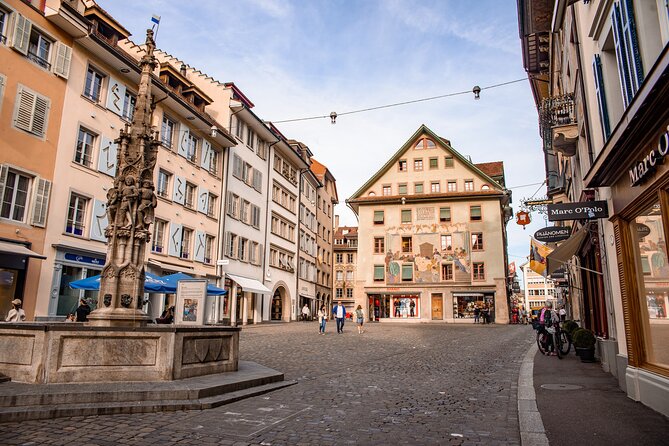
- Altstadt Lucerne walking rhythm: the Old Town’s narrow alleys, frescoed façades, and squares that lead naturally to the bridge zone
- Lion Monument gravity: the dying lion carved in 1821, created to commemorate the Swiss Guards who died in 1792
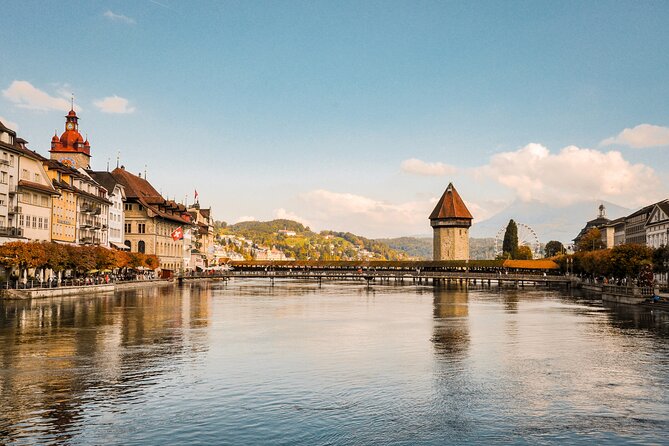
- Chapel Bridge restored after fire: built in 1333, partially destroyed in 1993, then restored with its 17th-century triangular paintings intact
From Bahnhof to Bridge Town: The 90-Minute Format
This is a private walking tour, meaning it is just your group. That matters in Lucerne, where you can either wander in circles or follow a plan that makes the landmarks click. With an approximate 1 hour 30 minutes duration and a start at Bahnhof6003 Lucerne, the tour is designed to give you a strong orientation without eating half a day.
I like the pace because it respects how Lucerne is laid out: you are not jumping all over town, you are moving through the core sights in a way that feels practical. Most stops also come with admission free access, so you do not end up doing the math on extra ticket costs mid-walk.
If you do have one planning note, it is this: 90 minutes goes quickly. If you are the type who wants to sit and sketch, or you need a lot of bathroom breaks, you will feel the time pressure. For me, that is the only real tradeoff in a tour built for first-time orientation.
Torbogen Luzern: A Fire-Surviving Arch With a Moral
You start at Torbogen Luzern, an archway originally part of the Lucerne train station built in 1896. The key story is not just age, it is endurance. In 1971, a devastating fire swept through the station complex, and this archway was the only surviving element.
That detail turns a simple street sight into a lesson. The inscription Sic transit gloria mundi is a reminder of how quickly human plans fade. When you see the arch in person, you can feel the idea behind it: Lucerne literally rebuilt around loss, and some physical pieces carried the message forward.
Why this stop is useful for you: it sets a tone for the whole walk. Later you will see other structures with scars, restorations, and meanings tied to power, faith, and loss. Torbogen is the opening chapter that makes the rest of the tour easier to understand.
More Guided Walks in Lucerne
- Lucerne: Private Walking Tour with a Local Guide
★ 4.6 · 450 reviews - Lucerne Walking & Boat Tour: The Best Swiss Experience
★ 4.5 · 417 reviews - Lucerne: Guided Walking Tour with an Official Guide
★ 4.7 · 321 reviews
Jesuit Church Lucerne: Counter-Reformation Baroque Up Close
Next comes the Jesuit Church Lucerne, built between 1666 and 1677. It is Switzerland’s first major Baroque church, and it was constructed by the Jesuits during the Counter-Reformation. That is an important context clue.
Baroque architecture was not neutral decoration. It was a strategy. In places like this, the design aimed to strengthen Catholic faith by using dramatic form and visual impact. So when you stand outside, you are not only looking at a pretty façade. You are looking at a message meant to be felt.
For your visit, this stop gives you a cultural anchor. Lucerne can look gentle and scenic from the lake, but this church reminds you the city also had religious and political momentum. The tour keeps it short, about 10 minutes, which is perfect if you want the big picture without getting pulled into a long detour.
Spreuer Bridge: The Wooden Bridge That Told Stories to the River
Spreuer Bridge is built in 1408, making it one of Lucerne’s historic wooden bridges. Originally, it was part of the city’s fortifications, and it had a practical job too, letting people dispose of chaff into the river. That is a detail I love because it makes the bridge feel less like a museum object and more like an everyday tool from centuries ago.
Then comes the art, and it is specific. The bridge is adorned with 67 paintings from the 17th century showing the Dance of Death. This is medieval imagery at work, shaped to confront the big reality that everyone ends up the same way, no matter their status.
A drawback to know: this is a short stop in a moving route. If you are a serious art fan, you might want extra independent time after the tour. You will get the main story here, but you may not have enough minutes to read every detail carefully.
Still, even a quick look is rewarding. The paintings transform the wooden bridge from a simple crossing into an outdoor moral lesson, and it fits perfectly between Lucerne’s older defensive layers and its more famous “postcard” bridges later on.
Luzern Altstadt: A Medieval Core You Can Actually Use
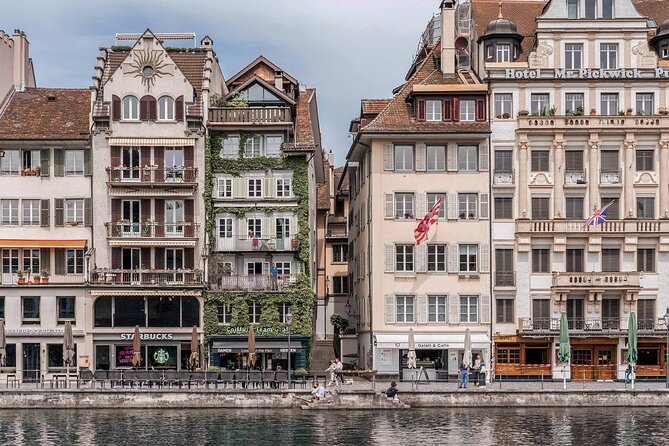
After the bridges and their symbolism, the tour moves into Luzern Altstadt, the Old Town. This is where the walking itself becomes part of the experience. You get to see how the medieval center is arranged, with charming squares, frescoed buildings, and narrow alleys that guide you almost like corridors.
For value, this stop helps you in a practical way. Once you understand where the Old Town sits relative to key bridges and landmarks, it becomes easier to plan the rest of your day. You will know where to head for more photos, where the best strolls are likely to start, and how to move without constantly guessing.
One other benefit: because the tour is private, your guide can adjust slightly to what you respond to more. If you are more interested in architecture than monuments, you can lean into the streets and façades. If you prefer famous memorials, you can mentally shift toward Lion Monument and the iconic bridge next.
Lion Monument: The Dying Lion and the Price of Loyalty
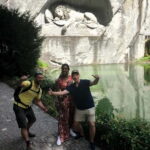
Then comes the most emotionally heavy landmark on the route: the Lion Monument. It was carved in 1821 and commemorates the Swiss Guards who died during the French Revolution in 1792. The depiction is a dying lion, symbolizing bravery and sacrifice.
This stop is powerful because it shifts Lucerne’s tone. The city has charming streets and scenic water, but this monument makes it clear that loss has been part of the city’s story too. Even if you are not a history buff, the symbolism is easy to grasp, and the stone form does the talking.
Time-wise, it is about 15 minutes. That is usually enough for one good look, some reflection, and photos without feeling like you are rushing through something meaningful. If you tend to avoid heavy memorials, you may still appreciate the context the guide gives, because it explains why people travel out of their way to see it.
Higher up, or further along the lake:
- From Zurich: Mount Titlis with Ice Flyer & Lucerne Day Tour★ 4.7 · 3,899 reviews
- Lucerne: Mt. Pilatus Cable Car, Cogwheel Train & Lake Cruise★ 4.7 · 2,338 reviews
- Mount Pilatus Summit from Lucerne With Lake Cruise★ 4.5 · 1,260 reviews
- Lucerne: Round-Trip Catamaran Cruise on Lake Lucerne★ 4.4 · 1,169 reviews
Chapel Bridge: The Icon, the Fire, and the Triangles of Time
Finally, you reach Chapel Bridge, the iconic wooden bridge built in 1333. It is one of the oldest bridges in Europe, and it is the visual shorthand for Lucerne. You will also see its 17th-century triangular paintings, which depict the city’s history.
One major reason this stop feels real is the restoration story. Chapel Bridge was partially destroyed by fire in 1993, then restored. So again, you are seeing a structure shaped by survival, not just age.
What this means for you: by the time you arrive at Chapel Bridge, you have already heard about Torbogen’s fire and Spreuer’s historical role. Chapel Bridge becomes more than a photo stop. You start noticing how Lucerne keeps rewriting itself after disruption while protecting what matters.
Practical tip for your walk: look at the bridge from different angles if you can. The guide’s route helps, but your own moving eye matters here. Those triangular paintings reward even brief attention, especially after you know they are part of the city’s story rather than random decoration.
Price and Value: What $51.83 Buys in Lucerne
At about $51.83 per person for roughly 1 hour 30 minutes, this tour is fairly priced for Switzerland, especially because it is private. The math gets better if you are two people or a small group, since the tour is built around your group rather than forcing you into a big crowd.
Here is the value logic I care about: you are paying for time-saving interpretation. Lucerne’s core sights are close together, but the meanings behind them are not always obvious at street level. A guide turns “I saw it” into “I understand why it looks like that,” which is what makes walking tours worth it.
Also, each stop lists admission ticket free access. That is a subtle but real value perk. You are not stuck planning around extra entry costs every time you reach a landmark. Your budget stays focused on the one thing you are buying, guidance.
One more planning detail: this tour is often booked about 21 days in advance on average. That does not mean you must book early for every trip, but it does suggest demand. If you have fixed travel dates, reserve sooner rather than later.
The Guide Factor: What a Benjamin or Jeremy-Style Tour Feels Like
The guide style is a big part of why this works. The tour experience is set up so you get a logical route and steady pacing, with time for questions. People have described guides such as Benjamin as enthusiastic, personable, and eager to answer questions, with the tour feeling like someone is showing you a favorite city, not lecturing at you.
Another guide name you might see is Jeremy, and the common thread in how this tour tends to run is practical orientation. If you are the kind of person who wants to leave with a mental map, the route is built for that. You will finish back at the meeting point, Bahnhof6003 Lucerne, with enough context to continue on your own without feeling lost.
It is also worth noting that the tour uses a mobile ticket and is offered in English, so you are not dealing with language friction while you walk.
Practical Fit: Who This Walking Tour Is Best For
This is a strong match if you:
- are short on time but want the core Lucerne landmarks in one plan
- want a guided way to understand what you see, especially bridges and memorials
- prefer a private experience where your group can move at a comfortable rhythm
It may be less ideal if you:
- need lots of long pauses for photos at each spot
- dislike heavier memorial moments, because the Lion Monument is part of the route
Most people can participate, and it is near public transportation, which helps if you are combining this with lake time or a day trip.
Should You Book This Guided Walking Tour of Lucerne?
Yes, if your goal is to understand Lucerne quickly and walk away with a map in your head, book it. It is short, private, and focused on the city’s most recognizable symbols, Torbogen, two major Baroque-and-medieval connections, two famous bridges, and the Lion Monument that changes the mood.
Book it especially if you like art and symbolism, because the details are not generic. Spreuer Bridge’s 67 Dance of Death paintings and Chapel Bridge’s triangular historical paintings become much more meaningful when someone explains what you are looking at.
If you have plenty of time and love lingering, you might still book it, but plan to add extra independent time after for the one or two stops you care about most. Think of this tour as your quick orientation and story primer, then let Lucerne pull you in.
FAQ
What is the duration of the Lucerne guided walking tour?
It lasts about 1 hour 30 minutes.
How much does the tour cost?
The price is $51.83 per person.
Where does the tour meet, and where does it end?
It starts at Bahnhof6003 Lucerne, Switzerland, and ends back at the meeting point.
Is the tour offered in English?
Yes, it is offered in English.
Is this tour private or shared with other groups?
It is private, so only your group participates.
Do I need tickets for the stops?
The stops listed on the route show admission ticket free access.
Is a mobile ticket provided?
Yes, the tour uses a mobile ticket.
Is free cancellation available?
Yes. You can cancel up to 24 hours in advance for a full refund.
Added lately around Lucerne



Walking Tours, compared.
Zurich Walking Tour With Cruise and Aerial Cable Car
Read our review →
Lucerne Walking & Boat Tour: The Best Swiss Experience
Read our review →
3 in 1: Zurich Walking Tour – Cruise on the Lake – Cable Car Ride to Felsenegg
Read our review →Browse the lists this tour appears in