
Reviewed · WALKING TOURS
Bern Audio guided walking tour 1h50 and 23 audio commentary
Bern has a way of rewarding slow walking.
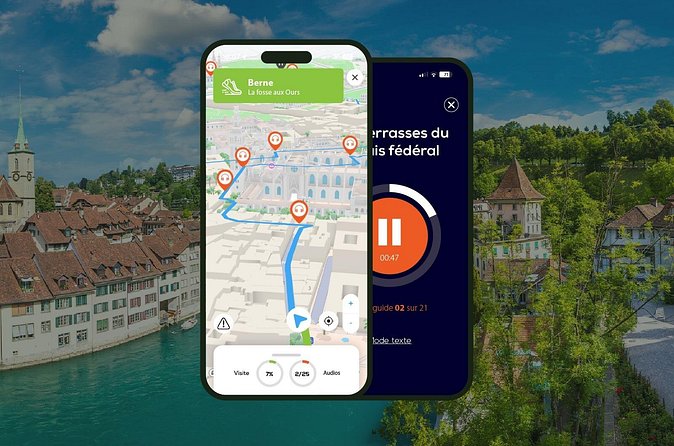
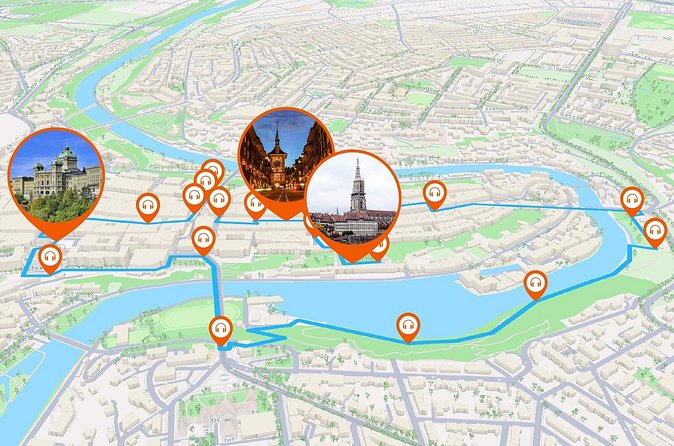
This self-guided audio tour turns a casual loop into a clear, story-filled stroll, and I like that it packs 23 audio commentaries into a manageable 1h50. You also get transcripts and an interactive 3D map so you are not just listening. The main catch is practical, bring a charged phone, and note that paid entrances along the route are not included.
I started at Bundesplatz and finished back where I began, which makes this easy to plug into a day of sightseeing. It is priced low for a group (up to 15), so it can be good value if you are traveling with a few people. One thing to consider: optional headphones are not provided, so you might want to plan for quiet listening.
In This Review
- Quick reasons this Bern audio walk feels worth it
- Before you go: phone setup and how you actually follow the route
- Entering Bern through Bundesplatz: government buildings and a smart starting point
- St. Vincent and the surprising fact that Bern once had no cathedral
- Bern’s water story: fountains everywhere, with engineering underneath
- Ogre Fountain and the darker side of civic art
- Grain Hall and municipal theatre: war reserves and culture in the same block
- Zytglogge clock tower: plan your timing for the moving figurines
- More fountains, more symbolism: Zähringen, Samson, Moses, and Justice
- Fountain of Zähringen
- Samson and the Lion
- Moses fountain
- Fountain of Justice, plus a street-name clue
- Terraces of St. Vincent: where history meets everyday play
- Bear town logic: why Bern’s legend still matters
- Views over the old town: Nydegg Bridge and the Aare
- Helvetiaplatz and museums: Einstein is not just a name
- Federal Palace terraces and the Bern Casino: panoramic walking energy
- Bundesplatz again, and the Anna Seiler Fountain’s moral symbolism
- The prison tower and the layered meaning of walls
- Einstein’s Swiss path: age 16, Zurich, and Mileva Maric
- St. Peter and St. Paul and the City Inn: different faiths and political rituals
- The Aare walk to Kirchenfeld: the route softens near the river
- Price and value: $7.86 per group can be a smart deal
- Who this Bern audio walking tour is best for
- Should you book this Bern Audio Guided Walking Tour?
- FAQ
- Where does the Bern audio walking tour start and end?
- How long is the walking tour?
- How many audio commentaries are included?
- Is it available offline?
- Do I need to download tickets or pick up materials?
- What language is the tour offered in?
- Are transcripts included?
- Are headphones provided?
- Is the price per person or per group?
- Are entrance fees included for places along the route?
- Can I get a refund if I cancel?
Quick reasons this Bern audio walk feels worth it
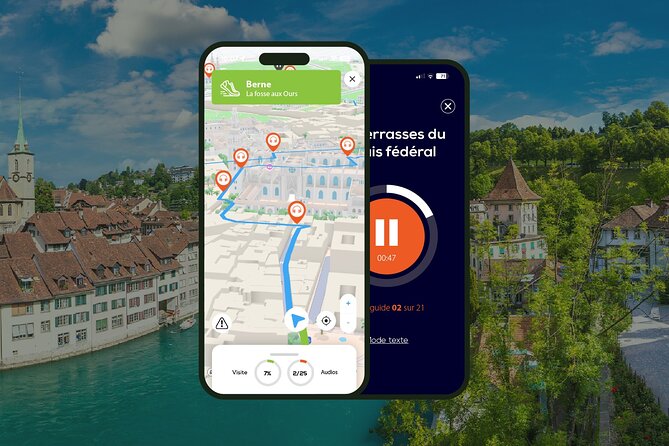
- You control the pace with a mobile ticket and no deadlines or expirations.
- 23 stops, not 3 or 5, so you get a real sense of Bern’s layers.
- Offline mode means no data stress while you are outside.
- A 3D navigation map helps you follow the loop and recover if you wander off course.
- Transcripts for every audio section make it easier to follow at your own speed.
- Photo recommendations help you aim your phone at the right moments.
Before you go: phone setup and how you actually follow the route
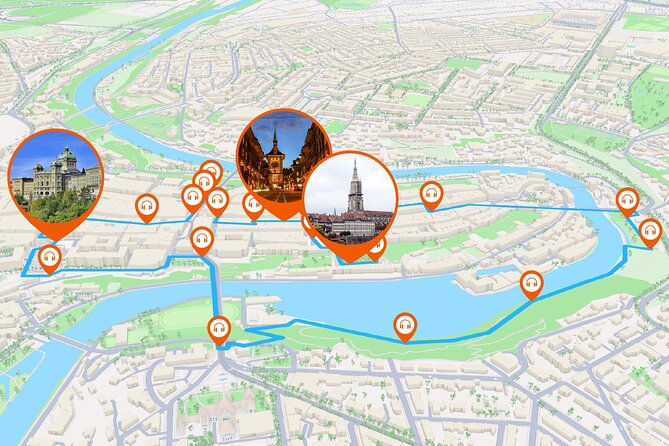
This is an app-based audio walk, so you will use your phone as your guide. The big advantage is that you get immediate access to the guided circuit, with no physical ticket or materials to pick up.
Plan on doing a quick check at the start:
- Download or enable offline mode before you begin.
- Confirm your language, the tour is offered in English (and the app also supports French and Spanish).
- If you want audio at a comfortable volume, bring headphones since they are optional but not included.
The walk is built as a loop. In real life that means you can take small detours, then get back to your place and continue.
Entering Bern through Bundesplatz: government buildings and a smart starting point
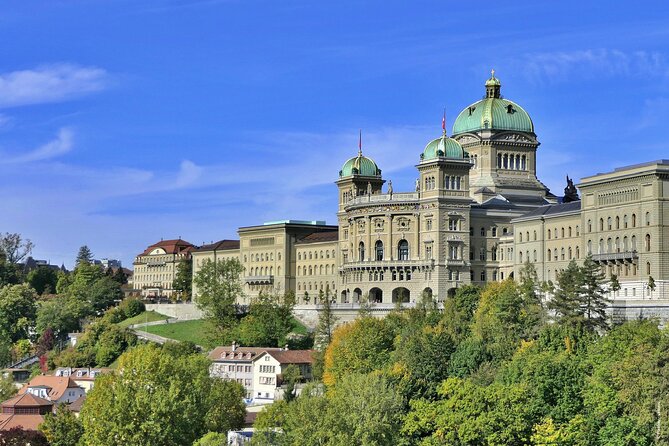
You start at Bundesplatz, across from the Federal Government Palace. Even if politics is not your thing, this is a great way to begin because it gives you a broad map of where you are in the city. Bern is the Swiss capital, so right here you are near the Federal Trip Tip and the Federal Assembly, the key institutions that shape national decisions.
From this open square, the audio guide also helps you shift from “I see buildings” to “I understand what I am seeing.” I like that it does not wait until later to give context. You pick up the tone of Bern early, both ceremonial and practical.
More Guided Walks in Bern
- Bern Walking Tour: Explore Top Sights & Hidden Gems
★ 5.0 · 108 reviews - Bern Private Walking Tour with a Local
★ 4.5 · 75 reviews - Bern: Private Walking Tour with a Local Guide
★ 4.9 · 57 reviews
St. Vincent and the surprising fact that Bern once had no cathedral
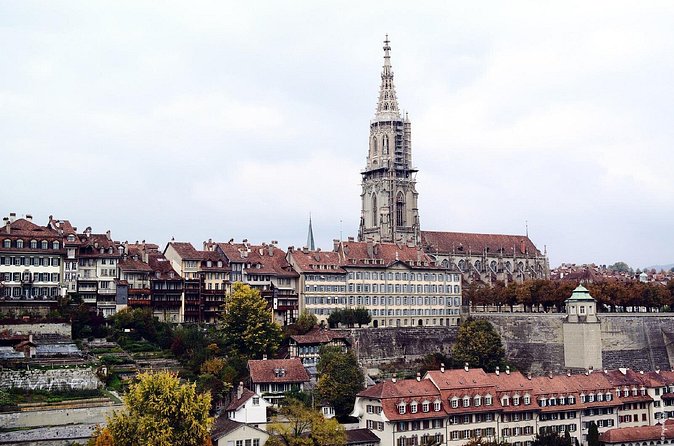
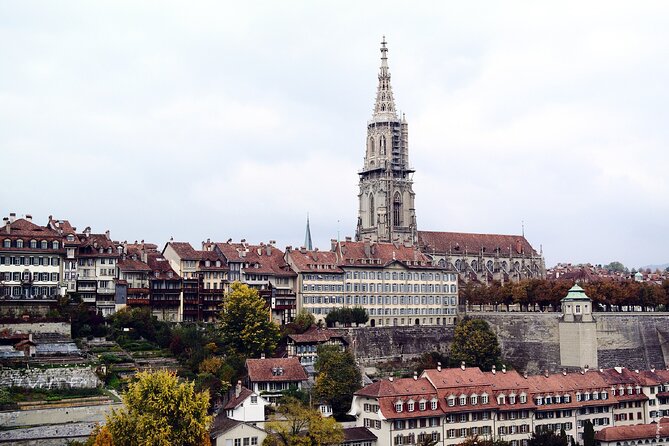
The tour quickly swings you toward the collegiate church of St. Vincent. It is easy to call it a cathedral, because it dominates the skyline, but the guide clarifies the nuance: it is the largest religious building of the late Middle Ages in Switzerland. It also explains a key historical point that helps you read the city correctly.
Bern in the 15th century was a major power north of the Alps, yet it had no cathedral. That detail changes how you look at the old center. You start noticing status, but also compromises and local choices that shaped the skyline.
Bern’s water story: fountains everywhere, with engineering underneath
Very soon you realize one of Bern’s trademarks is water. The route points out how dotted the city is with fountains, and it ties that to real infrastructure.
You learn that the city already had many water points by the 13th century, and the supply came through an underground creek. That creek fed wells and cisterns. This is one of those tour moments where history turns practical. You stop seeing fountains as decoration only, and you start seeing them as part of how the city worked day to day.
Ogre Fountain and the darker side of civic art
At the Ogre Fountain, the guide shares the colorful meaning behind the name. In French, it is tied to the literal idea of the devour of little children. It is not exactly cheerful, but it is memorable, and that is often what makes a fountain worth a pause.
Grain Hall and municipal theatre: war reserves and culture in the same block
You pass the Municipal Theater of the City of Bern, a neo-Baroque opera house that opened in 1903, built by architect René Von Wurstemberger and financed by a private company. Right next to it sits the old Grain Hall, built in the 1710s.
The guide’s explanation is what I appreciated most. The Grain Hall was not just a pretty historic facade. It stored grains to have a reserve in case of war or famine. That single purpose makes the building feel grounded and real.
If you like contrasts, this section delivers. You have theater culture on one side and survival planning on the other. And you understand why Bern invested in both.
More Self-Guided Trails in Bern
- Self-Guided Reading City Tour in Bern★ 3.9 · 19 reviews
- Self-Guided Audio City Tour in Bern★ 4.3 · 18 reviews
- Self-Guided Audio City Tour in Bern★ 4.0 · 17 reviews
- Bern Scavenger Hunt and Highlights Self Guided Audio Tour★ 4.0 · 14 reviews
Zytglogge clock tower: plan your timing for the moving figurines
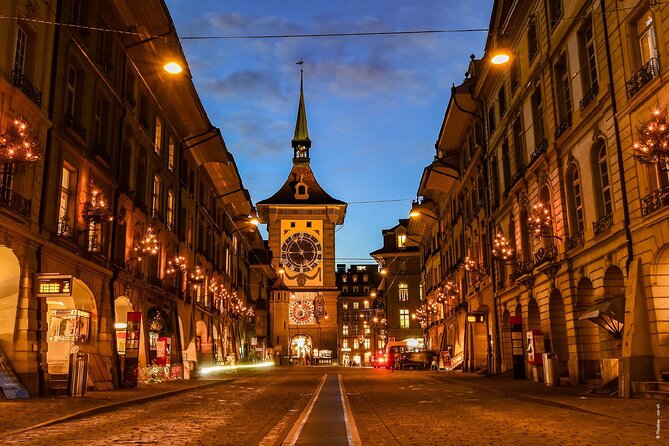
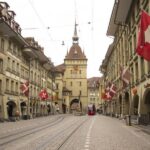
The Zytglogge is one of Bern’s signature sights, and the audio guide gives you a simple way to experience it properly. Every full hour, you get the show of the carousel of medieval figurines.
The guide also adds a nice timing trick: 3 minutes before the hour, the chime starts. The mechanism behind it is described as a hand-activated 16th century mechanism. That means you are not just waiting for the big moment. You can time your stop so you catch both the setup and the performance.
Practical tip: if you are doing this on a schedule-heavy day, consider hovering near the clock tower for the final minutes rather than rushing past. This is the kind of sight where “close enough” is not the same as “caught the whole show.”
More fountains, more symbolism: Zähringen, Samson, Moses, and Justice
Bern loves fountains that teach. This walk keeps that theme moving with stop after stop.
Fountain of Zähringen
You see the fountain named for Zähringen, tied to the man who founded Bern in 1191. Built in 1535, the guide notes that the original basin was octagonal. That small detail is the kind of thing you would miss if you only took a photo and kept walking.
Samson and the Lion
Next is Samson and the Lion, created in 1544 by Hans Gieng. It is tied to the Biblical story from the Book of Judges. It is a good reminder that these are not “random sculptures.” The city used public art to communicate stories people already knew.
Moses fountain
Then comes the Moses fountain, also built in 1544 but damaged by a storm. That makes Bern’s public art feel less like museum glass and more like something that has lived through weather and time.
Fountain of Justice, plus a street-name clue
You end up at the fountain of Justice, and the guide includes a language-based hint about the street name meaning Street of Justice (it frames it as helpful even if you are not doing German language study). This kind of “word clue” is practical. It helps you remember what you learned, and it nudges you to notice street names as signals, not just labels.
Terraces of St. Vincent: where history meets everyday play
A standout moment is the terraces of the Collegiate Church, formerly a church cemetery. Today they are a meeting spot, with intergenerational activity like pétanque and table tennis.
I like that the guide does not treat this as a museum zone. It is a place locals actually use. Once you hear this, the terraces make sense as a living space rather than a scenic backdrop.
Bear town logic: why Bern’s legend still matters
The tour brings in the bear story, which is more than a mascot lesson. It explains the legend that in 1191, Duke Berthold V of Zähringen decided to create a city for the peasants from the surrounding area.
When you understand that origin story, the bear icon stops feeling like a tourist souvenir. It becomes part of how the city frames identity.
Views over the old town: Nydegg Bridge and the Aare
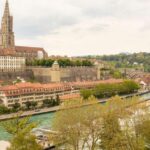
You reach a traditional viewpoint of Bern’s old town and get a clear sense of how the city fits around the river.
You look toward Nydegg Bridge, which crosses the Aare, and the audio highlights four cottages at the ends of the bridge deck. It is a small detail, but the guide uses it as a way to anchor your bearings.
Helvetiaplatz and museums: Einstein is not just a name
At Helvetiaplatz, the route points out several museums. The one that looks like a castle is the Bern History Museum, which traces the city’s story from the Middle Ages to the present. The audio also flags a specific reason to care: there is a permanent exhibition on Einstein on the 2nd floor.
This is one of the tour’s strengths: it connects what you see outside with what you might want to explore inside. Even if you do not go into the museum that day, you now know what you are looking at and why it matters.
Federal Palace terraces and the Bern Casino: panoramic walking energy
Next, you move to terraces around the Federal Palace. The guide emphasizes how these terraces give you panoramic views and access to the nature surrounding the city.
Then you pass the Bern Casino, which opened in the 1900s and was recently renovated. The guide frames the renovation goal as creating a social house, combining cultural, event, and culinary life under one roof. That matters because Bern’s public spaces are not all about grand monuments. Some are built for regular social use, which makes the city feel less frozen in time.
Bundesplatz again, and the Anna Seiler Fountain’s moral symbolism
The route returns you toward the Bundesplatz area and the Federal Government Palace. You are reinforced on Bern’s capital role at this point, which helps because the city can otherwise feel like a storybook old town. This is where the storybook and the real-world seat of government meet.
You then see the Anna Seiler Fountain. Built in 1545 to replace an older 14th century fountain, it depicts a woman filling a bowl of water with a jug. The symbol tied to this statue is temperance.
That word matters because it gives you a way to read civic art. You start noticing not just what it shows, but what virtue it is meant to represent.
The prison tower and the layered meaning of walls
One of Bern’s iconic images is its prison tower. The guide tells you the version you see is more recent, but it connects it to the original structure built between 1256 and 1344. Back then it served as a city gate and watchtower.
I like this kind of interpretation. It helps you see the urban design as defense plus control, not just “historic towers.” When you walk near it, you understand why it sat where it did.
Einstein’s Swiss path: age 16, Zurich, and Mileva Maric
The audio guide includes an Einstein mini-biography tied to Bern. It notes that Einstein was born in Germany, but came to Switzerland at 16. The following year he joined the Federal Polytechnic of Zurich, where he met Mileva Maric, whom he married in 1903.
Again, this is not just trivia. It turns a city stop into a meaningful connection to ideas that travel beyond borders.
St. Peter and St. Paul and the City Inn: different faiths and political rituals
You visit the Church of St. Peter and St. Paul. The guide describes it as the first Catholic building in Bern and also the episcopal seat of the Christian Catholic Church in Switzerland. It was built at the end of the 19th century, following an international architectural competition.
Right next to it is the City Inn, nicknamed the Little Brother of the Federal Palace. The audio adds a practical observation: when the flag of Bern is raised on the roof, politicians are inside. It also says that the seven members of the Trip Tip meet weekly here, in the Government Inn.
That small “flag rule” is exactly the kind of detail that makes a city feel lived-in.
The Aare walk to Kirchenfeld: the route softens near the river
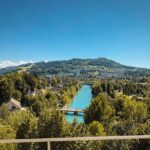
The last stretch is a shaded walk along the Aare to a large metal bridge in Kirchenfeld. The guide reminds you what the Aare is: Switzerland’s main river, originating in the Bernese Alps and flowing into the Rhine in Koblenz.
This closing segment works well because the walk finishes calmer than it began. You are no longer sprinting between landmarks. You get a breather before returning to Bundesplatz.
Price and value: $7.86 per group can be a smart deal
At $7.86 per group for up to 15 people, the math can work in your favor. You are not paying per person for a live guide. Instead, you are buying access to a self-paced circuit with 23 audio comments, text transcripts, offline mode, and interactive navigation.
That is especially good if:
- you want flexibility to pause for photos or detours,
- you are traveling with 2 or more people,
- you like learning as you go rather than doing a museum first and reading later.
The main value question is whether you will actually use the app and audio. If you prefer silent wandering only, it may feel like extra effort. If you like stories while you walk, it is a strong fit.
Who this Bern audio walking tour is best for
This tour is a solid match if you want:
- a first-time Bern overview that still feels specific,
- a way to understand landmarks like Zytglogge, the fountains, and the river without getting lost,
- a budget-friendly option that does not depend on joining a fixed group schedule.
It may be less ideal if you only care about one or two sights and do not want a loop. Also, if you plan to enter multiple paid attractions along the way, remember that entrance fees are not included.
Should you book this Bern Audio Guided Walking Tour?
If you want to feel oriented in Bern fast, and you enjoy learning through audio stories, I would book it. The pricing per group is genuinely friendly, and the mix of stops covers both the postcard Bern stuff (clock tower, fountains, old town views) and the practical explanations (water systems, grain reserves, the city’s evolving functions).
Book it if you will use offline mode and follow the route with the 3D map. Skip it if you want a purely spontaneous walk with no phone involved, or if you are only here for a single quick stop.
FAQ
Where does the Bern audio walking tour start and end?
It starts at Bundesplatz, 3011 Bern, Switzerland and ends back at the same meeting point.
How long is the walking tour?
The duration is about 1 hour 50 minutes.
How many audio commentaries are included?
You get 23 audio commentary stops.
Is it available offline?
Yes. It includes offline mode so you can listen during the visit without data consumption.
Do I need to download tickets or pick up materials?
No. You get immediate access to the audioguided circuit with a mobile ticket, and there are no materials to collect.
What language is the tour offered in?
It is offered in English, and the app also supports French and Spanish.
Are transcripts included?
Yes. There are text transcripts of all audio content.
Are headphones provided?
Headphones are not included. They are optional, so you may want to bring your own.
Is the price per person or per group?
The price is listed as $7.86 per group (up to 15 people).
Are entrance fees included for places along the route?
No. Entrance fees to paid establishments along the route are not included.
Can I get a refund if I cancel?
Yes. You can cancel for a full refund if you cancel at least 24 hours before the experience’s start time.
Audio-Guided Bern
- Beautiful Bern’s Legends: A Self-Guided Audio Tour
★ 4.5 · 7 reviews - Zurich: City Bus Tour with Audio Guide and Lake Cruise
★ 4.3 · 1,195 reviews - Basel: Sightseeing Bus Tour with Audio Guide
★ 4.1 · 377 reviews - Zurich City Tour with Audio Commentary
★ 4.0 · 372 reviews
Added lately around Bern



Walking Tours, compared.
Zurich Walking Tour With Cruise and Aerial Cable Car
Read our review →
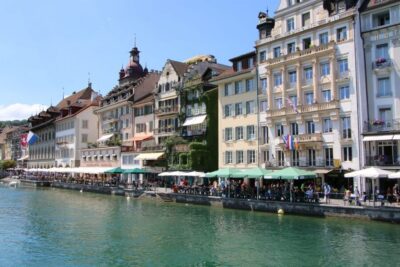

Lucerne Walking & Boat Tour: The Best Swiss Experience
Read our review →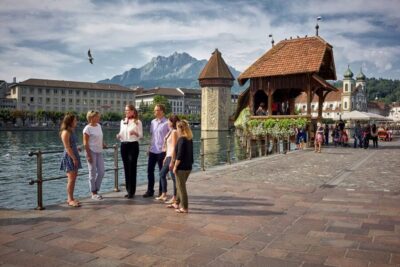
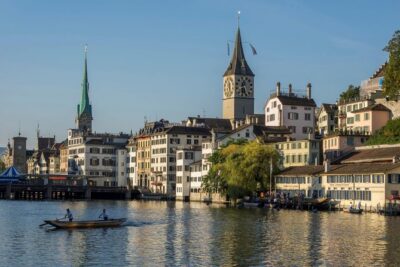
3 in 1: Zurich Walking Tour – Cruise on the Lake – Cable Car Ride to Felsenegg
Read our review →Browse the lists this tour appears in